Extracts
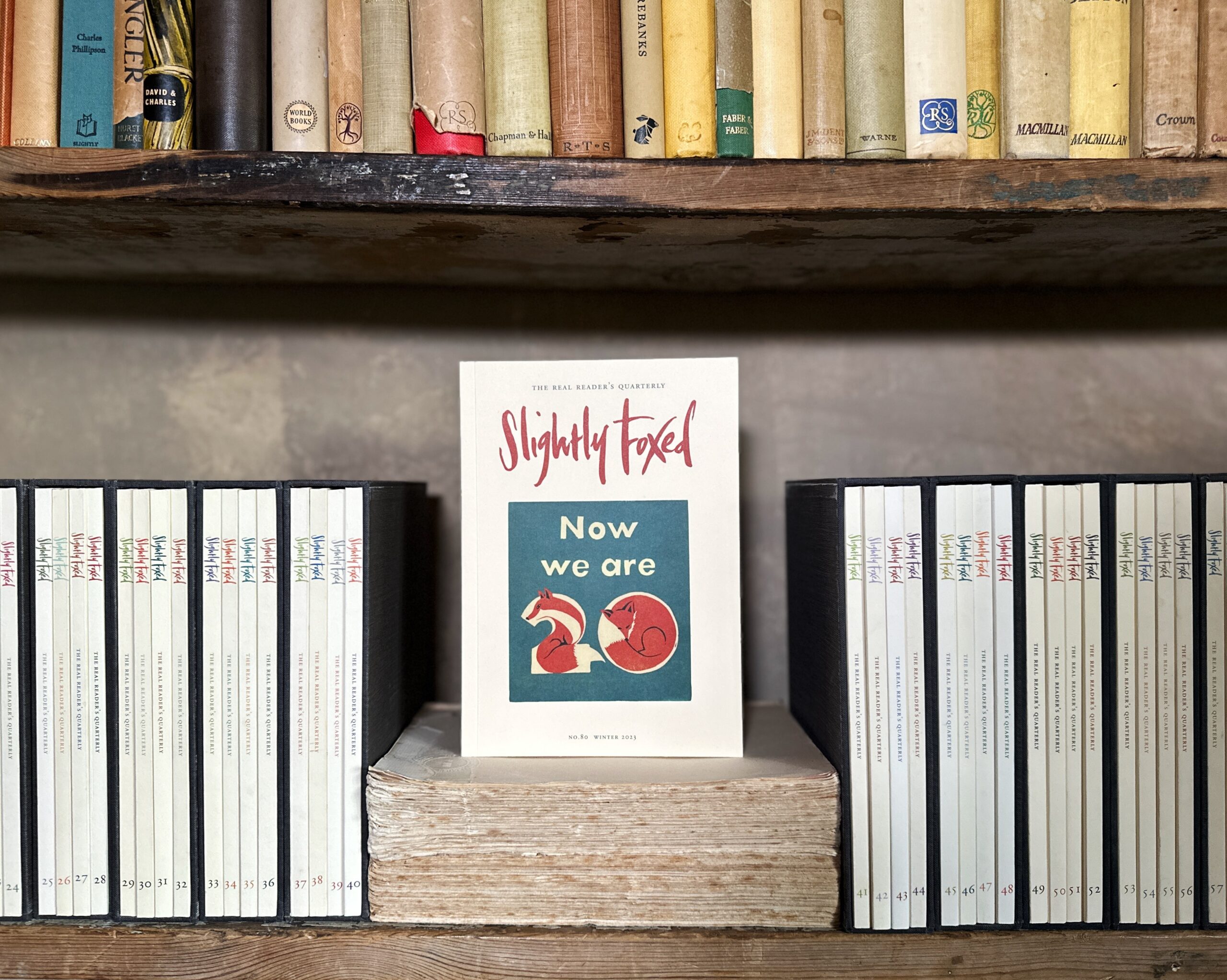
To give you a taste of Slightly Foxed, we’ve selected a few extracts of articles from some of our back issues.
To see part of a recent issue please click here: Slightly Foxed Issue 24 Sample
Don't Give up the Day Job
If there were teenage novels in the 1950s, I never found them. Instead the gap between Last Term at Malory Towers and the foothills of serious literature was plugged, most enjoyably, by period adventure stories. Two types appealed. In the first, fair-haired young Englishmen, armed only with a first-class degree from Cambridge and ‘a little Hindustani’ became unwilling players in the Great Game on the North West Frontier. In the second, a rail journey across between-the-wars Europe plunged ordinary men, often from Haslemere, into a maelstrom of violence and treachery . . .
I first read Graham Greene’s Stamboul Train when I was 12 and the set-up was instantly recognizable . . . It was Greene’s fourth novel and he badly needed a success. Married and still in his late twenties, he had already committed what his family must have seen as career suicide. He had surrendered the status of leader-writer on The Times and the comfort of a coal fire in the subs office in order to write fiction. One might quite reasonably argue that a working life that started at four o’clock in the afternoon already allowed plenty of leeway for other writing. But Greene, immensely private, constitutionally restless, was not a natural employee. Furthermore, he had just been cursed with one of the cruellest fates that can befall a young writer – he had written a very well-received first novel.
‘Don’t give up the day job till your fifth novel,’ John (Room at the Top) Braine once gruffly advised me adding, with the characteristic short ‘a’ of his Bradford upbringing, ‘Frances, you don’t know if you can do it till then.’ But Graham Greene thought he did know, and made the painful discovery that, though one book about your own psyche may interest the punters, three on the trot has them bulk buying J. B. Priestly instead.
Frances Donnelly on Graham Greene’s Stamboul Train (Issue 22)
J. C. T. Jennings and the Problem of Evil
A brand-new brown trunk, inscribed with my name and school number, had been acquired weeks ago. My mother had immediately begun assembling, name-tagging and ticking off items from a printed schedule sent to her by Matron, and then laying them neatly in the trunk. Meanwhile, no doubt to prime me, I was given a Jennings book to read, one of a series of prep-school stories written by Anthony Buckeridge. I was soon comprehensively hooked, and began working my way methodically through all eight existing titles, from Jennings Goes to School, first published in 1950, to the latest, Thanks to Jennings. Three days before the start of term, with my trunk packed at last, I was brimming with Jennings-fuelled excitement.
Then a virulent Asian flu struck. I woke the following morning feeling alternately hot and cold, with a pounding head and a lacerating cough. Over the next fortnight, I did little but lie in bed drinking Robinson’s Lemon Barley and rereading my Jennings books. Feverishly rereading them. Many children welcome illness as an escape from school. Jennings and his friend Darbishire gave me the paradoxical consolation of taking me out of the sickroom and into the classroom. It seemed to me a classroom of delight . . .
Robin Blake on Anthony Buckeridge’s Jennings books (Issue 17)
Do You Mind Me Just Asking?
There are some questions that you should never ask a writer – they are instant death to any hoped-for conversation. But at every literary party or book launch I’ve ever attended, the worst of them invariably pops forth like a cork from a champagne bottle, straight into the writer’s eye: Do you write by hand or use a computer?
The Paris Review has been boldly posing such questions to writers since 1953 when this seminal literary magazine was founded in Paris by Harold L. Humes, Peter Matthiessen and George Plimpton, often travelling to the writers’ homes to accept their hospitality before plunging in with all those hoary old favourites. Do you use a notebook? Do you write in the mornings or at night? Have you had run-ins with friends or writers whose books you’ve reviewed?
It’s not surprising then that some of the writers, often the most interesting, have a slightly grumpy tone as they strive to maintain dignity, purpose and patience. In a conversation that took place in New York in 1956, William Faulkner (pencil – paper – whisky) appears almost as a parody of himself, like a famous Shakespearean actor gamely taking part in Coronation Street.
Interviewer: What techniques do you use to arrive at your standard?
Faulkner: Let the writer take up surgery or bricklaying if he is interested in technique . . .
Linda Leatherbarrow on The Paris Review Interviews, Vol. 2 (Issue 20)
Travels with the Father of History
Like all good storytellers (and precious few academics), Herodotus appreciates he has to keep his audience interested. It’s thought that the Histories was written to be performed aloud in symposia across the Greek world, the fifth-century BC equivalent of a talk and book-signing, perhaps, or a high-minded but lively series of Reith lectures. So the prose rattles joyously on, Herodotus’s effervescent personality bubbling through in 1,086 first-person interventions. There are gossipy asides, numerous digressions, nudges and winks scattered pell-mell throughout the text. He embraces the weird and the wonderful – as he embraces life – with a zest you can still feel across the divide of two and a half millennia: dog-headed men who live in mountains, the gold-digging ants of India, bigger than a fox, smaller than a dog, and the fabulous flying snakes of Arabia. It was these sorts of tall stories that landed Herodotus in the soup with Plutarch, who took Cicero’s Father of History moniker and spitefully renamed the Greek historian the Father of Lies. Never mind that Herodotus was, more often than not, scrupulous in sourcing his stories. ‘I am obliged to record the things I am told, but I am certainly not required to believe them,’ he explains . . .
Justin Marozzi on Herodotus’ Histories (Issue 20)
Sound Nonsense
The words rolled out, natural and clear, and I listened with new ears and understanding. Enlightenment had finally come. Passages spoken aloud in an Irish accent, by someone who loved the prose enough to commit long passages to memory, released the book’s power. Its beauty had been unlocked not by a literary intellectual, but by a half-tight man in a cheap suit standing at the bar of a Dublin pub. Finnegans Wake was revealed as a work of sound rather than sense, a form of high falutin’, Gaelic, literary rap. Ireland talking in her sleep . . .
I explained to the man the revelation that his passionate recitation had brought about, and told of my previous scepticism and bewilderment. He was exhilarated at the news of my conversion, a mood consolidated by the offer of a drink. ‘A pint would keep the whistle whetted,’ he said. ‘We will drink side by side beside the Liffey, and the sloothering slide of her, giddygaddy, grannyma, gossipaceous Annalivia’ . . .
Christopher Robbins on Finnegans Wake (Issue 22)
A Pash for Nash
Miss Twye was soaping her breasts in the bath
When she heard behind her a meaning laugh
And to her amazement she discovered
A wicked man in the bathroom cupboard.
Miss Twye – what a wonderful name. She could have been a librarian, or perhaps a superior shop assistant. Quite soon, however, I gave up imagining myself in that cupboard and moved on to another bath-time poem, ‘Samson Agonistes’, in the same collection.
I test my bath before I sit,
And I’m always moved to wonderment
That what chills the finger not a bit
Is so frigid upon the fundament.
This is by Ogden Nash, of course. As well as expressing a profound truth, it did wonders for a boy’s vocabulary. Since then, Nash’s couplets have always been floating about in my mind like notes of old favourite tunes . . .
Oliver Pritchett on the poems of Ogden Nash (Issue 24)
Another Country
He was a farmer, certainly, but one who used his privileged education, literary skill and painterly eye (his mother had been an artist) to bring his adopted world to life. Adrian Bell saw his world as a series of paintings, as detailed as any Brueghel: the men dressing barley in the barn under gothic beams were actors in a medieval mystery play; the farmers conferring in Stambury market, each with a hand on a bullock’s back, seemed to be swearing on a sacred relic. He marked the way hens pause, questioningly, with a leg in the air and head on one side, and the perpetual expression of disgust on the face of a turkey; he saw the moorhen rising from the pond before dawn ‘scarring the calm surface with its trailing feet’ . . .
Christian Tyler on Adrian Bell’s Corduroy (Issue 22)
Social Climbing
One winter afternoon, browsing in a second-hand bookshop, I found a book called Cambridge Nightclimbers, by ‘Hederatus’. (Hedera is the Latin for ivy, probably the world’s most talented climber). Inside the cover was a red ink stamp: ‘Cambridgeshire Libraries: WITHDRAWN FROM STOCK’ it declared, intriguingly. I flicked through the book. It was part-memoir, part-guidebook, written under a pseudonym in 1970 by a student who had spent his years at the university scaling the city’s buildings – sacred and profane – and evading the porters.
‘Buildering’ he and his friends called their sport, and they were very good at it indeed. The Fitzwilliam Museum had fallen to them, as had King’s College Porter’s Lodge (‘It is essential to climb the clock-face up the right-hand side . . .’) and even, most impressively, the twin towers of King’s College Chapel (‘Tradition, height, beauty, severity all combine to make it the goal of everyone’s ambition . . .’). The lady who sold me the book said it had been withdrawn from circulation in libraries because it was a danger to public health.
Each night the following week I dressed in black, eased on my climbing slippers and went out alone, or with my friend Simon, pulling myself up by Gothic bosses, lodging my toes in spandrels, clutching at trefoils – each one of whose upper curves fitted the palm of a hand exactly – and shaking masonry grit from my hair when I got home . . .
Robert Macfarlane on Hederatus’ Cambridge Nightclimbers (Issue 23)
An Eagle in the Attic
I never met Betsy but in Querencia Stephen Bodio lets you see her plain. Steve was from a working-class area of Boston and of Irish-Italian roots, while Betsy was the late-life daughter of Bishop D. T. Huntington, forty years a missionary in China: ‘When I was born we converted the village; if I had been male, we would have converted the province.’ Betsy’s was a well-established New England family, with Mitfordian older sisters (who had founded a Trotskyite commune on Beacon Hill) and a useful family inheritance. Betsy took her money and ‘bought a Mercedes and drove at furious speeds through the Pyrenees, took at least one driving lesson from Juan Fangio, helped a boyfriend buy a Caribbean island, and met a parade of dazzling and dubious characters’. Although this approach would have been unlikely to be blessed by the Bishop, she settled down, put herself through university and made a living of sorts as a journalist. After all, if you have seen Noël Coward, naked, playing a piano in Jamaica, you are ready for anything . . .
Jeff Nicoll on Stephen Bodio’s Querencia (Issue 19)
The Eyesight of Wasps
I discovered Niko Tinbergen’s Curious Naturalists as a student. I was reading psychology and the course had just begun with a look at animal behaviour, which involved a grasp of scientific method and thus a lot of headache-inducing maths. In a bookshop, glumly casting round for some background reading with a lighter touch than the papers I’d been given, I happened on this remarkable book, published surprisingly by Country Life. It was about seagulls, savage wasps, camouflage and other matters now suddenly on my agenda but, because it was for ordinary readers rather than specialists, the ordeals of theory, statistical bafflement and so forth were wonderfully absent. There were plenty of intriguing illustrations too, many of them really quite odd. In one, a man in a floppy hat was presenting a real butterfly with a paper butterfly on the end of a thread. In another, a stuffed fox was being towed by a jeep towards a colony of gulls. Over time I came to relish the contrast between Heath Robinson arrangements like these and the strange truths they could uncover. Even right there in the shop I got a glimpse of the fun there could be in ingenious detective work . . .
Grant McIntyre on Niko Tinbergen’s Curious Naturalists and The Herring Gull’s World (Issue 19)